

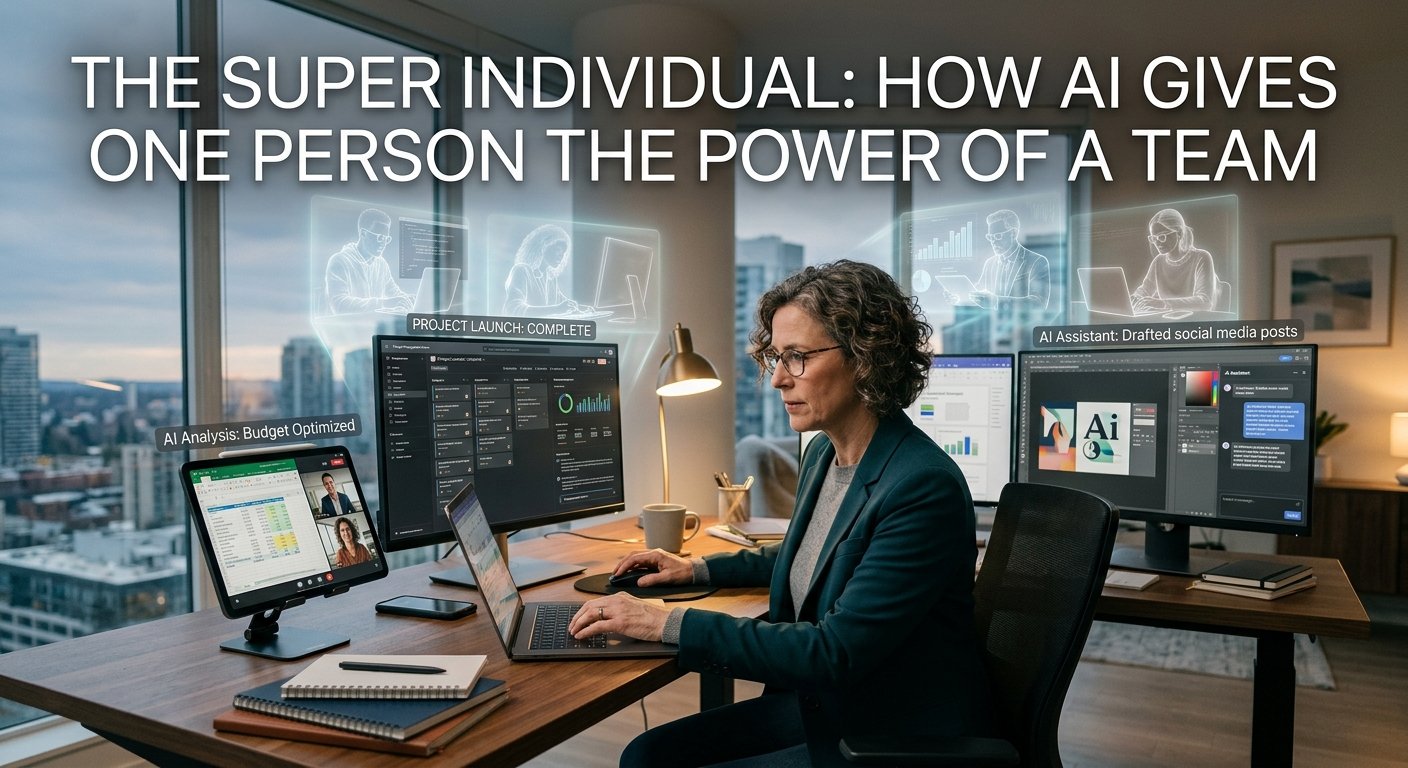
For most of human history, accomplishing something significant required other people.
A merchant needed clerks, accountants, and messengers.
A newspaper needed editors, writers, researchers, and designers.
A software company needed programmers, testers, product managers, marketers, and customer support.
Even a talented entrepreneur eventually reached a limit imposed not by imagination, but by the number of hours available in a day.
Then AI began to change the equation.
At first, artificial intelligence looked like a faster search engine. Then it became a writing assistant, a coding assistant, a designer, an analyst, and a research partner.
But something much bigger is now emerging.
AI is beginning to give a single person access to capabilities that once required an entire team.
This creates a new kind of individual:
The Super Individual.
Not someone who works harder than everyone else.
Not someone who knows everything.
But someone who can direct intelligence, coordinate digital workers, and turn ideas into execution at extraordinary scale.
The End of the One-Person Limitation
The traditional economy has always been constrained by specialization.
One person might be excellent at strategy but poor at design.
Another might understand marketing but know little about programming.
A third might be a talented researcher but have no ability to build a product.
That is why organizations exist.
A company is, in many ways, a machine for combining specialized human abilities.
The founder creates the vision.
The engineer builds the product.
The designer creates the experience.
The marketer finds customers.
The accountant manages the numbers.
The lawyer manages risk.
The operations team keeps everything moving.
The larger the ambition, the larger the organization traditionally had to become.
AI begins to break this relationship between ambition and organizational size.
A single person can now ask an AI system to research a market, analyze competitors, write a strategy, generate a prototype, produce marketing materials, analyze data, create software, translate content, and automate repetitive processes.
The individual is no longer limited to the skills contained inside one human mind.
The person becomes the orchestrator.
And that is the fundamental shift.
From Assistant to Digital Workforce
The first generation of AI was largely conversational.
You asked a question.
AI gave you an answer.
You asked for a paragraph.
AI wrote it.
You supplied a problem.
AI suggested a solution.
Useful, certainly—but fundamentally reactive.
The emerging generation of AI agents is different.
An agent can be given a goal and then perform multiple steps toward that goal, sometimes using tools, interacting with software, analyzing information, revising its work, and continuing until it reaches a useful result.
That changes the basic unit of work.
Instead of:
Human → Prompt → Answer
the model increasingly becomes:
Human → Goal → AI plans → AI executes → Human reviews
This distinction is enormous.
OpenAI’s 2026 research on agentic work describes this transition as a move from short interactions toward delegated, longer-horizon tasks. By May 2026, more than 70% of sampled individual Codex users had made at least one request estimated to represent more than an hour of human work.
The important point is not the number.
It is the direction.
AI is moving from something you consult toward something you delegate to.
And once delegation becomes reliable, one person can begin managing something that resembles a small digital organization.
Your AI Team May Have No Employees
Imagine a person running a business with five invisible colleagues.
One AI agent acts as a researcher.
It monitors industries, competitors, customers, and emerging trends.
Another acts as a writer.
It turns research into articles, newsletters, reports, and social content.
A third acts as a programmer.
It builds prototypes, fixes bugs, analyzes code, and automates repetitive technical work.
A fourth acts as an analyst.
It examines spreadsheets, identifies patterns, creates forecasts, and challenges assumptions.
A fifth acts as an operations assistant.
It organizes information, tracks projects, prepares documents, and keeps the entire system moving.
None of these workers needs a desk.
None needs a commute.
None needs to attend a meeting.
And increasingly, they do not need to be activated one at a time.
They can operate as components of a larger system.
The human becomes the person sitting above the system—not necessarily doing every task, but deciding what deserves to be done.
This is the emergence of the AI-powered individual.
The New Competitive Advantage Is Not “Knowing AI”
There is a temptation to think that the people who win the AI era will simply be those who know the most AI tools.
That is probably too shallow.
Tools change quickly.
The deeper advantage is the ability to design systems of work.
Consider two people with access to exactly the same AI model.
Person A uses it to write emails faster.
Person B uses it to build a research system that continuously gathers information, evaluates opportunities, creates drafts, tests ideas, analyzes results, and feeds the lessons back into the next decision.
They have the same technology.
But they do not have the same capability.
The difference is not the model.
It is the architecture of work.
This may become one of the defining skills of the next decade.
The Super Individual Is an Architect
The traditional employee asks:
“What should I do?”
The AI-enabled professional increasingly asks:
“What should I delegate, what should I automate, and what should I personally decide?”
That is a very different question.
The value of the individual gradually moves upward.
Away from repetitive execution.
Toward judgment.
Away from information collection.
Toward interpretation.
Away from producing every individual piece of work.
Toward designing the system that produces the work.
This does not mean humans become less important.
It may mean that certain human abilities become dramatically more important.
Taste.
Judgment.
Curiosity.
Strategic thinking.
Communication.
Empathy.
Leadership.
The ability to recognize what matters.
AI can generate ten strategies.
The human must decide which one deserves to exist.
AI can write one hundred versions of an article.
The human must recognize which one actually says something worth reading.
AI can generate thousands of possibilities.
The human must decide which possibility is worth pursuing.
The bottleneck moves.
And whenever the bottleneck moves, the nature of work changes.
Intelligence Becomes Less Scarce
For centuries, intelligence was expensive.
If you wanted expert legal analysis, you needed a lawyer.
If you wanted sophisticated financial analysis, you needed an analyst.
If you wanted software, you needed programmers.
If you wanted professional design, you needed designers.
AI does not eliminate the need for expertise.
But it changes the economics of accessing it.
A person who previously could afford one specialist may now be able to access many forms of specialized digital intelligence at very low marginal cost.
This is potentially transformative for entrepreneurs, creators, researchers, students, independent professionals, and small businesses.
A two-person company may be able to operate with capabilities that once required twenty people.
A solo creator may be able to publish at the scale of a small media organization.
An independent developer may be able to research, build, test, market, and support a product without assembling a large organization.
The important change is not simply that AI makes people faster.
It is that AI lowers the minimum organizational size required to attempt ambitious things.
That may prove to be one of the most consequential economic effects of AI.
Small Teams Become Dangerous
For decades, large organizations enjoyed an enormous advantage.
They had money.
They had departments.
They had specialists.
They had infrastructure.
They could afford inefficiency because they had scale.
But large organizations also have friction.
Meetings.
Approvals.
Hierarchy.
Coordination.
Internal politics.
Communication overhead.
The larger the organization becomes, the more energy is spent coordinating people rather than creating value.
AI introduces a fascinating counterforce.
A small team equipped with powerful AI systems can potentially move with the speed of a much larger organization.
There is less communication overhead.
Fewer handoffs.
Fewer layers of management.
Faster experimentation.
Faster iteration.
The future may therefore not belong exclusively to the largest companies.
It may belong to organizations that combine small human teams with extremely capable AI systems.
Research from Microsoft describes a similar shift in which AI agents increasingly take on execution while humans gain more room for direction, decision-making, and ownership.
The result is not necessarily “AI replaces teams.”
It may be:
AI makes small teams behave like much larger ones.
But There Is a Hidden Danger
The Super Individual sounds powerful.
It is.
But power without direction can become chaos.
One person with twenty AI agents can generate an enormous amount of output.
That does not mean the output is valuable.
In fact, AI may create a new problem:
Too much execution.
A person can suddenly produce more articles than anyone can read.
More software than anyone can maintain.
More marketing campaigns than anyone can evaluate.
More ideas than anyone can properly develop.
The limiting factor shifts from production to selection.
This is why simply adding more AI agents is not necessarily progress.
Recent discussions around personal AI agents have already exposed this problem: people can accumulate many agents without necessarily creating more meaningful productivity. The number of agents is much less important than whether they produce measurable value.
A super individual therefore needs something more important than an army.
They need a compass.
The New Scarcity: Attention
When intelligence becomes abundant, attention becomes more valuable.
When creation becomes cheap, judgment becomes more valuable.
When information becomes infinite, relevance becomes more valuable.
When execution becomes automated, purpose becomes more valuable.
This creates a strange paradox.
AI may give an individual extraordinary power while simultaneously making it easier for that individual to become overwhelmed.
The person who asks AI to do everything may end up managing everything.
The person who builds an endless collection of agents may become the manager of a digital bureaucracy.
That is not freedom.
The goal is not to create more activity.
The goal is to create more leverage.
The Super Individual Still Needs Human Judgment
There is another reason the human remains central.
AI can optimize within a framework.
Humans decide what the framework should be.
AI can predict.
Humans decide what is worth pursuing.
AI can generate.
Humans decide what is meaningful.
AI can imitate.
Humans decide what is authentic.
And AI can execute a poorly defined objective with extraordinary efficiency.
That last point may become one of the greatest dangers of the AI age.
A machine that is extremely good at doing the wrong thing is more dangerous than a machine that simply does nothing.
Therefore, the Super Individual is not the person who gives AI maximum autonomy.
It is the person who knows where autonomy should stop.
The Rise of the One-Person Company
The long-term implications are difficult to overstate.
Imagine a future in which a person can launch a global digital business without first hiring a large team.
The founder develops the concept.
AI researches the market.
AI builds the first product.
AI creates the website.
AI prepares the marketing.
AI translates the product into multiple languages.
AI analyzes customers.
AI handles routine support.
AI monitors performance.
AI identifies problems.
The founder provides judgment, direction, relationships, trust, and vision.
Such a company would not be “a company without workers.”
It would be something new:
a company in which human intelligence is amplified by a permanent layer of machine intelligence.
This is already moving beyond theory. Organizations are experimenting with human-agent workforces, while research increasingly focuses on how humans and agents divide responsibility rather than simply whether AI can perform isolated tasks.
The one-person company may therefore become far more capable than its name suggests.
The Super Individual Is Not a Superhuman
There is an important distinction.
The Super Individual is not someone who suddenly becomes capable of doing everything.
The human being remains limited.
They still sleep.
They still get distracted.
They still make emotional decisions.
They still lack expertise in many fields.
They still need other people.
AI does not remove human limitations.
It changes the relationship between those limitations and what the individual can accomplish.
The person no longer needs to personally perform every specialized task.
They need to know how to mobilize intelligence around a goal.
That is a very different kind of power.
The New Career Question
For decades, career advice focused on specialization.
Become a great programmer.
Become a great designer.
Become a great marketer.
Become a great accountant.
Become an expert.
That advice is not going away.
But it is being supplemented by a new question:
Can you combine your expertise with AI systems to accomplish what previously required an organization?
The most valuable people may increasingly be those who possess both:
deep human expertise + AI orchestration ability.
A doctor who can intelligently use AI may outperform a doctor who cannot.
A lawyer who can build AI-assisted research systems may outperform one who relies entirely on traditional workflows.
A marketer who can orchestrate research, content, testing, analytics, and automation may operate at an entirely different scale.
A founder who understands both customers and AI systems may build a company with dramatically less organizational overhead.
The advantage is not simply knowing AI.
It is knowing how to think with AI.
From Employees to Orchestrators
The industrial age rewarded people who could operate machines.
The information age rewarded people who could operate computers.
The AI age may increasingly reward people who can orchestrate intelligent systems.
That means asking better questions.
Breaking complex goals into smaller problems.
Assigning tasks to the right systems.
Checking outputs.
Creating feedback loops.
Building repeatable workflows.
Knowing when to automate.
Knowing when to intervene.
And, perhaps most importantly, knowing what not to automate.
This is closer to architecture than traditional productivity.
The person is designing an organization made partly of software.
A New Definition of Leverage
For a long time, leverage came from four major sources:
Capital.
People.
Technology.
Distribution.
AI introduces a new form of leverage:
intelligence on demand.
A person with access to powerful AI can potentially multiply their ability to research, create, analyze, communicate, and execute.
But leverage is neutral.
A hammer can build a house or break a window.
AI can multiply excellence.
It can also multiply confusion.
The difference lies in the person holding the system.
That is why the coming era may produce an unusual divergence.
Two people may have access to exactly the same AI.
One may become dramatically more capable.
The other may simply become dramatically busier.
The technology is identical.
The outcome is not.
The Real Superpower
The ultimate advantage of AI may therefore not be artificial intelligence itself.
It may be human intention amplified by artificial intelligence.
The person who knows what they want, why they want it, and how to organize intelligence around it can accomplish things that previously required a team.
Not because the human suddenly became smarter.
But because the human gained access to a scalable layer of intelligence.
This changes the meaning of being an individual.
For centuries, being alone meant being limited by what one person could physically and intellectually accomplish.
In the AI age, being alone does not necessarily mean working alone.
You may have a researcher beside you.
A programmer beside you.
An analyst beside you.
A writer beside you.
A strategist beside you.
A translator beside you.
A designer beside you.
And yet all of them may exist as software.
The person remains one.
The capability does not.
The Next Era Belongs to the Orchestrators
The first wave of AI taught people how to ask machines questions.
The next wave is teaching machines how to pursue goals.
The wave after that may be about something even more profound:
teaching one human how to command an ecosystem of intelligence.
That is where the idea of the Super Individual becomes important.
The future may not simply be about companies with thousands of employees competing against companies with fewer employees.
It may increasingly be about individuals and small teams equipped with unprecedented leverage.
A person with a clear vision, strong judgment, domain expertise, and a well-designed AI system may be capable of operating at a scale that once belonged only to organizations.
But the deepest lesson is not that AI makes one person powerful.
It is that AI changes the unit of power itself.
The individual no longer has to be measured only by what they can personally do.
They can be measured by what they can direct, create, coordinate, and bring into existence.
That is the real emergence of the Super Individual.
Not a human replaced by machines.
Not a machine pretending to be human.
But a human who has learned how to turn intelligence into leverage.
And perhaps, for the first time in history, one person may be able to carry the productive power of an entire team—without becoming a team of one.
The Super Individual is not the end of human collaboration.
It is the beginning of a new form of collaboration between one human mind and an expanding ecosystem of artificial intelligence.