

For generations, the ideal worker was easy to understand.
Be knowledgeable.
Work hard.
Gain experience.
Become efficient.
Master your profession.
The better you became at your craft, the more valuable you became.
But artificial intelligence is quietly changing the rules.
A machine can now write, calculate, research, translate, analyze, design, summarize, code, and organize information at extraordinary speed.
Tasks that once took hours can take minutes.
Work that once required several people can sometimes be done by one person working with AI.
Something deeper is happening beneath this technological transformation.
AI is not simply changing the jobs we do. It is changing the kind of worker we need to become.
The Worker of the Past
For much of modern history, productivity depended on specialization.
A company needed people who knew accounting, programming, marketing, design, research, sales, writing, and administration.
Each person occupied a particular place in the machine.
Expertise was valuable because expertise was scarce.
If you knew how to do something that few others could do, you had an advantage.
But AI is beginning to make many forms of expertise more accessible.
A person with little programming experience can ask AI to explain code.
Someone who has never studied graphic design can generate visual concepts.
A small business owner can use AI to analyze customer feedback.
A writer can research unfamiliar subjects in minutes.
A student can receive explanations adapted to their level of understanding.
The walls around specialized knowledge are becoming lower.
And when knowledge becomes easier to access, the definition of expertise begins to change.
From Knowing More to Doing More
The emerging worker does not necessarily know everything.
Instead, they know how to find, evaluate, combine, and apply what they need.
This is an important distinction.
Imagine two people given the same AI system.
One uses it as a faster search box.
The other treats it as a thinking partner.
The first asks for an answer.
The second asks for possibilities.
They challenge the response.
They request alternatives.
They test assumptions.
They combine the machine’s suggestions with their own experience.
The difference is not technological.
It is intellectual.
The new worker is not simply someone who knows how to use AI.
The new worker knows how to think with AI without surrendering the responsibility to think.
The Rise of the AI-Native Worker
A new generation is beginning to enter the workforce without seeing AI as a separate technology.
For them, asking an AI system for help may feel as natural as opening a browser or sending a message.
They may not think of themselves as “AI users.”
They simply work in an environment where intelligence is increasingly available on demand.
This creates a new kind of professional.
An AI-native worker may be able to move between disciplines more easily.
A marketer can understand basic data analysis.
A designer can create a prototype.
An entrepreneur can research a market.
A writer can investigate a complicated subject.
A small team can perform work that once required an entire department.
The boundaries between professions begin to blur.
And that may produce one of the most interesting consequences of the AI revolution:
The future worker may be defined less by a single profession and more by the ability to connect many kinds of knowledge.
The End of the Job Description?
Traditional job descriptions were built around tasks.
Write reports.
Analyze numbers.
Answer customers.
Manage schedules.
Create presentations.
Write code.
But AI is particularly good at tasks.
That means the task-based definition of work may gradually become less important.
Instead, employers may increasingly value people who can define problems, make decisions, manage uncertainty, communicate clearly, and take responsibility for outcomes.
The question may shift from:
“Can you perform this task?”
to:
“Can you make something valuable happen?”
That is a much larger question.
And it is much harder to automate.
Judgment Becomes a Superpower
AI can produce an answer.
But an answer is not necessarily a solution.
AI can generate a business idea.
That does not mean the idea deserves investment.
It can write an argument.
That does not mean the argument is true.
It can analyze a problem.
That does not mean it understands the human consequences of a decision.
As AI becomes more capable, human judgment becomes increasingly important.
Someone must decide what matters.
Someone must recognize when an answer sounds impressive but is wrong.
Someone must understand the context that cannot be captured in a prompt.
Someone must accept responsibility when a decision has consequences.
This is why the future may reward people who develop something that no software update can easily install:
good judgment.
Curiosity Will Matter More
There is another quality the new worker will need: curiosity.
When AI can answer routine questions instantly, merely having answers becomes less impressive.
The valuable person may be the one who asks a question nobody else thought to ask.
Why are customers leaving?
What assumption are we making?
What if the problem is not the product but the way we explain it?
What happens if we approach this from the opposite direction?
What opportunity are we overlooking?
Curiosity creates movement.
It turns information into discovery.
And in a world overflowing with generated information, the ability to discover something genuinely useful may become one of the greatest professional advantages.
Human Skills Become More Human
There is an unexpected paradox in all of this.
The more intelligent machines become, the more valuable certain human qualities may become.
Empathy.
Taste.
Courage.
Communication.
Leadership.
Creativity.
Patience.
Wisdom.
The ability to read a room.
The ability to inspire trust.
The ability to understand why a customer is frustrated even when their words say something else.
These abilities are difficult to reduce to instructions.
They emerge from experience, emotion, culture, relationships, and judgment.
AI can help a manager prepare for a difficult conversation.
But the manager still has to walk into the room.
AI can suggest a beautiful design.
But someone still has to decide whether it feels right.
AI can generate a hundred marketing campaigns.
But someone must understand which one will resonate with real people.
Technology can amplify human ability.
It does not eliminate the need for humanity.
One Person May Become a Small Company
Perhaps the most remarkable change will happen at the individual level.
A person with a strong idea once needed a team.
A writer needed an editor.
An entrepreneur needed researchers.
A small business needed designers, marketers, analysts, and technical support.
AI is beginning to compress these functions.
One person can now research an idea, create a prototype, write the copy, analyze the market, generate visuals, automate repetitive tasks, and communicate with customers—with AI assisting along the way.
This does not mean everyone will become a successful entrepreneur.
It means the distance between having an idea and building something real is becoming shorter.
The individual is gaining leverage.
And leverage changes everything.
The Most Valuable Workers May Be Connectors
The future may not belong exclusively to the deepest specialist or the broadest generalist.
It may belong to the connector.
Someone who understands enough about technology to use it.
Enough about business to recognize opportunity.
Enough about people to understand desire.
Enough about design to recognize quality.
Enough about communication to tell a compelling story.
And enough about their own values to know what should—and should not—be built.
AI makes it easier to cross boundaries.
The person who can connect those boundaries may become extraordinarily powerful.
But There Is a Danger
There is a darker side to this transformation.
If AI makes work easier, people may become less thoughtful.
If machines provide instant answers, curiosity may weaken.
If algorithms make decisions for us, judgment may atrophy.
If AI writes everything, our own ability to express an idea may slowly become weaker.
Convenience always carries a price.
The greatest danger may not be that AI becomes too intelligent.
It may be that humans become too dependent on it.
The new worker therefore needs a strange kind of discipline:
Use AI aggressively—but preserve the ability to work without it.
Let AI expand your capabilities.
Do not let it replace your mind.
The New Definition of Productivity
For a long time, productivity meant doing more in less time.
But perhaps that definition is no longer enough.
If AI allows everyone to produce more, then production itself becomes less distinctive.
The real question becomes:
What are you producing, and why does it matter?
Ten thousand words are not necessarily better than one meaningful paragraph.
A hundred business ideas are not necessarily better than one good idea.
A thousand generated images are not necessarily more valuable than one unforgettable image.
In an age of abundance, selection becomes an art.
The new worker will need to know not only how to create, but how to choose.
Not only how to move quickly, but when to slow down.
Not only how to optimize, but what is worth optimizing.
The Worker Is Becoming the Director
Perhaps this is the deepest change of all.
For centuries, workers were often valued for how well they executed instructions.
AI is increasingly capable of execution.
So human value moves upward.
From doing to directing.
From producing to deciding.
From following processes to designing them.
From answering questions to defining them.
The worker becomes something closer to a director of intelligence.
They decide what needs to happen.
They assemble the right tools.
They ask the right questions.
They evaluate the results.
They make the final judgment.
And they remain responsible for the outcome.
The Future Will Not Be Human vs. AI
The most interesting future may not be one in which humans compete against machines.
It may be one in which individuals who know how to work with intelligent systems outperform those who refuse to adapt.
The competitive advantage will not necessarily belong to the person with the most powerful AI.
It may belong to the person who can combine AI with something machines do not possess in the same way:
experience, intuition, values, taste, courage, and purpose.
The future worker will therefore be neither purely human nor purely technological.
They will be a new combination.
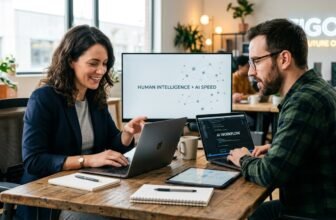
Human judgment.
Machine intelligence.
Human imagination.
Machine scale.
Human purpose.
Machine speed.
Together, these create something neither side can achieve as effectively alone.
Becoming the Worker of the Future
The AI revolution is still young.
No one knows exactly which professions will disappear, which will evolve, and which entirely new ones will emerge.
But one thing is becoming increasingly clear.
The safest strategy is not to become an expert at one tool.
Tools will change.
Models will improve.
Interfaces will disappear and reappear.
What remains valuable is the ability to learn, adapt, question, create, and decide.
The future worker will not ask:
“What can AI do for me?”
They will increasingly ask:
“What could become possible if I learned to work with it well?”
That is a very different question.
And perhaps that question marks the beginning of a new era of work.
AI is not simply creating new jobs.
It is creating a new kind of worker—one who can stand between human imagination and machine intelligence, and turn the possibilities of both into something real.
The future may belong to those who understand that AI is not the replacement for human potential.
It is a new kind of leverage for those who know how to use their potential well.