

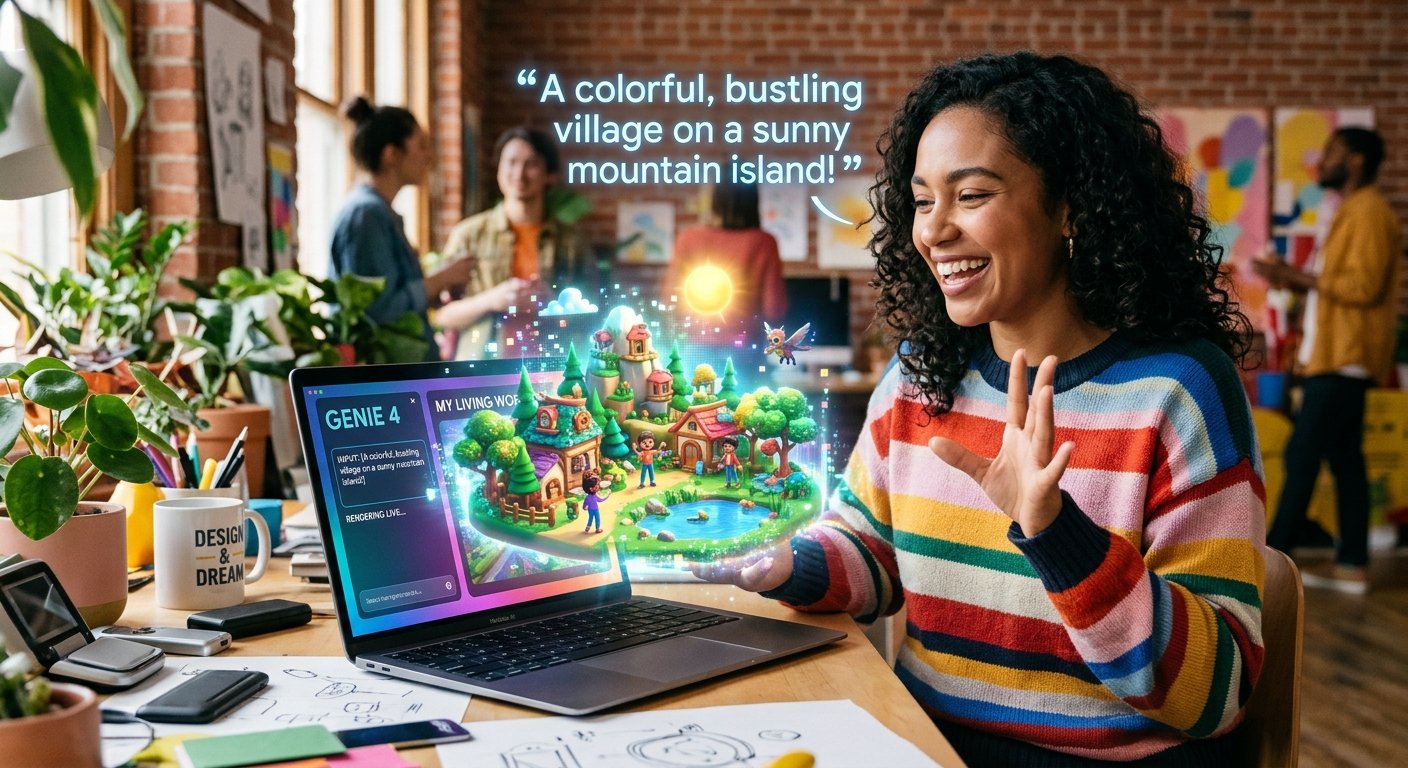
Imagine describing a mist-covered forest, a sunlit coastal village, or an entire fantasy kingdom—and then stepping inside it, exploring its landscapes, hearing its sounds, and changing what happens around you. What once belonged to the imagination of game designers and the technical expertise of developers is moving closer to an entirely new form of digital creation.
On October 27, 2026, Google DeepMind unveiled Genie 4, its latest AI world model, marking another significant step toward interactive virtual environments that can be generated and reshaped in real time.
Rather than simply creating an image or a video, Genie 4 aims to build a world that responds to you.
Beyond Images and Videos: Worlds You Can Explore
Generative AI has already transformed how people create pictures, write stories, and produce videos. Yet these creations are generally viewed from the outside. Genie 4 points toward a different experience: a digital environment that users can enter, navigate, and influence.
With a natural-language prompt, users can describe a setting and begin exploring the resulting environment using keyboard controls. As the simulation unfolds, they can issue additional instructions to change the weather, introduce new characters, adjust the camera, or alter elements of the scene.
Want a peaceful meadow to become a stormy wilderness? Curious about what happens when a new character enters a deserted city? Instead of rebuilding an entire scene from scratch, users can guide the experience as it develops.
According to Google DeepMind, Genie 4 can sustain simulations for up to approximately two minutes—around twice the duration of its predecessor, Genie 3.
This may sound brief, but the significance lies not simply in the length of a simulation. It lies in the possibility of turning an idea into an interactive experience with remarkably little technical preparation.
A World That Looks, Moves, and Sounds More Real
One of Genie 4’s most notable advances is its ability to generate audio alongside visual environments.
Its simulations can include environmental sounds, music, and interactive dialogue. Characters can respond to users and events, making the experience feel less like watching a silent digital landscape and more like inhabiting a living world.
The model also advances visual realism, movement, and the simulation of physical interactions. Google describes improvements in areas such as collisions, aerodynamics, and the natural movement of people.
These capabilities are important because immersion depends on more than beautiful scenery. A convincing virtual world must also respond in ways that feel coherent. The sound of wind should belong to the landscape; a character’s movements should make sense within the scene; and events should unfold with a degree of continuity.
Genie 4 seeks to bring these elements together, combining world generation with reasoning capabilities from Google’s Gemini model family.
What Could Genie 4 Mean for Gaming?
The gaming industry is among the most immediately intriguing areas of potential application.
Traditionally, creating a sophisticated game environment requires teams of artists, programmers, designers, animators, and sound specialists. Even developing a small playable prototype can demand substantial time and resources.
AI-generated worlds could eventually change parts of this process.
Independent creators might experiment with environments before committing to full production. Designers could test different visual styles, explore alternative storylines, and communicate ideas through interactive demonstrations rather than static concept art.
Players, too, may eventually expect more responsive experiences—worlds that adapt to their decisions rather than following a completely predetermined sequence.
However, Genie 4 should not yet be mistaken for a complete game-development platform. Its short simulation duration and experimental nature mean that substantial work remains before such technology can reliably support complex, persistent commercial games.
Its potential is significant, but the path from an impressive demonstration to a finished product is still long.
Beyond Gaming: Film, Education, and Robotics
The implications extend well beyond entertainment.
For filmmakers, interactive world models could become tools for visualizing scenes, testing camera movements, and exploring alternative staging before filming begins.
In education, they could eventually help students investigate historical settings, explore scientific concepts, or experience simulated environments that would otherwise be inaccessible.
Researchers may also use generated worlds to study how AI agents and robots perceive surroundings, respond to changing conditions, and complete tasks. Carefully designed simulations can offer controlled environments for testing behaviors before deploying systems in the physical world.
Architecture, product design, and industrial training could also benefit from faster ways to visualize and explore proposed environments.
These are potential applications rather than guarantees. Their practical value will depend on accuracy, reliability, cost, accessibility, and how well the technology performs under real-world requirements.
The Challenges Behind the Promise
Despite its advances, Genie 4 remains an early-stage research preview.
AI-generated environments can still lose consistency over time. Objects may change unexpectedly, physical interactions may be imperfect, and complex scenes may not preserve every detail after repeated modifications. Producing accurate text and maintaining precise spatial relationships also remain challenging areas.
Access is another consideration. Google DeepMind has begun providing the model to a limited group of trusted testers, with broader access planned through Project Genie for Google AI Ultra subscribers and through selected developer channels.
For now, Genie 4 is best understood as a glimpse of what interactive AI environments may become, rather than a universally available tool ready for every creator.
The Future: From Generating Content to Creating Experiences
Perhaps the most important shift represented by Genie 4 is a change in how we think about artificial intelligence.
The first wave of generative AI taught us to ask machines to produce something: an image, an article, a melody, or a video.
The emerging generation of world models invites a more ambitious question: What if AI could create a place where things happen—and where we can participate in what happens next?
That distinction could reshape the relationship between human imagination and digital technology. Instead of merely describing an idea and receiving a finished piece of content, creators may increasingly describe a possibility, enter the resulting environment, and refine it through interaction.
Genie 4 does not make that future a certainty. Yet it offers a compelling demonstration of the direction in which AI research is moving.
The next frontier may not be a more beautiful picture or a more convincing video. It may be a world that feels increasingly alive—one that begins with a few words and grows through the choices we make inside it.
For more developments in artificial intelligence, emerging AI tools, and the technologies shaping tomorrow, explore IgoAiList.com.
Explore More on IgoAiList
- How to Use OpenAI Codex for Real-World Software Projects
- OpenAI Codex CLI: Complete Guide for Developers
- OpenAI Codex App: Features, Workflow and Use Cases
The future is unfolding.
Discover what comes next.
Step into iGoAIList, a growing space for artificial intelligence, emerging technologies, remarkable tools, and ideas shaping the world ahead.
Create your account and stay connected to the discoveries, innovations, and possibilities that are redefining what technology can do.

