
ChatGPT Work and Multi-Agent AI: Can One Person Now Run an Entire Business?

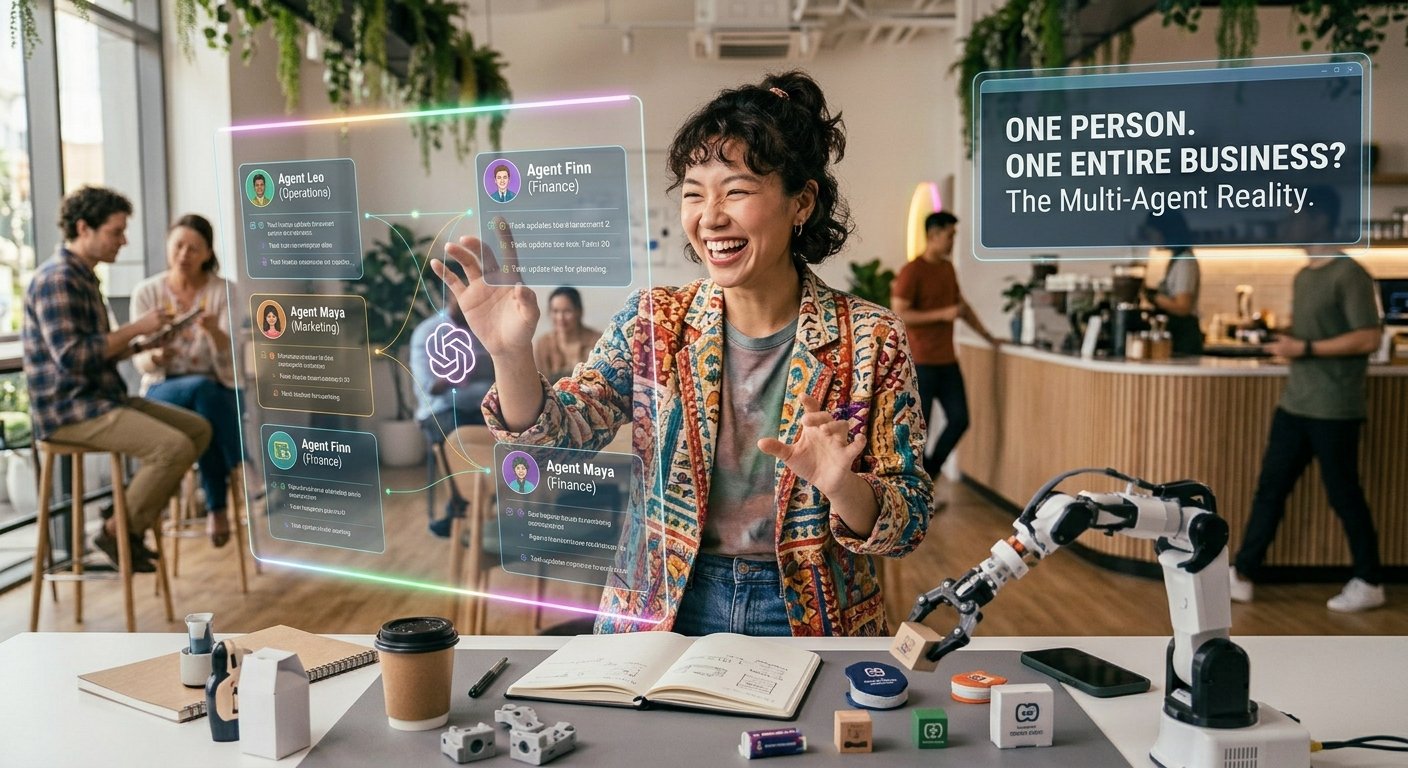
One person. Multiple AI agents. A completely new business model.
The future of business isn’t about building bigger teams. It’s about building smarter ones.
AI doesn’t just change how we work. It changes what one person can achieve.
The traditional business model has always required people, departments, budgets, and infrastructure. Research teams gather information. Marketing teams create campaigns. Analysts study performance. Administrators coordinate operations. Managers make decisions and ensure everything moves forward.
But what happens when one person can delegate many of these responsibilities to AI agents?
A new era of business is emerging. With ChatGPT Work, multi-agent AI systems, and increasingly capable automation tools, individuals and small businesses can coordinate complex projects with a level of efficiency that once required an entire team.
The question is no longer simply whether AI can help people work faster. It is whether one person, supported by a carefully organized network of AI agents, can operate a business that previously required several employees.
1. From AI Assistant to AI Workforce
Traditional AI assistants respond to individual questions. You ask for an article, receive a draft, request revisions, and then move on to the next task.
AI agents represent a different approach.
Instead of simply answering questions, agents can be assigned specific responsibilities, use approved tools, work through multiple steps, and return completed deliverables. Some systems can also coordinate several agents, allowing independent tasks to proceed simultaneously.
OpenAI introduced ChatGPT Work in July 2026 as an agent designed for longer, more involved tasks. It can research information, analyze files, work across connected applications, and produce documents, spreadsheets, presentations, reports, and websites.
This represents an important shift: from asking AI to perform isolated tasks to assigning it responsibility for an entire workflow.
The emerging AI workforce is not necessarily made up of human employees. It can consist of specialized digital agents working together under human direction.
2. How a Multi-Agent Business Could Work
Imagine a small online business operated by one entrepreneur.
Rather than personally handling every responsibility, the owner establishes a team of specialized AI agents.
Each agent has a clearly defined role.
The Research Agent
Investigates markets, competitors, customer needs, industry developments, and business opportunities. It gathers information from multiple sources and prepares research briefs.
The Content and Marketing Agent
Transforms research into articles, website content, social media posts, email campaigns, and promotional materials. It follows the company’s brand voice and marketing strategy.
The Data Analysis Agent
Examines website traffic, search performance, customer behavior, advertising results, and sales figures. It identifies trends and suggests areas for improvement.
The Business Strategy Agent
Reviews research and performance reports, compares opportunities, evaluates risks, and prepares strategic recommendations for the business owner.
The Operations Agent
Helps organize projects, track deadlines, prepare reports, coordinate approved applications, and maintain routine administrative workflows.
The Quality Control Agent
Reviews the work produced by other agents, checks factual accuracy, identifies inconsistencies, and ensures that important requirements have not been overlooked.
The human owner remains the decision-maker. AI agents perform delegated work, while the owner establishes priorities, reviews results, and approves important actions.
The real advantage comes not from having more AI tools, but from giving each one a defined responsibility within a coordinated system.
3. A Practical Example: Running an Online Business with AI
Consider an entrepreneur launching an international digital publishing and marketing business.
A conventional approach might require a researcher, writer, SEO specialist, marketing coordinator, data analyst, and project manager.
With an AI-supported workflow, one person could organize much of this work into a connected process.
Step 1: Discover an opportunity
The research agent studies market demand, identifies underserved audiences, compares competitors, and prepares a market opportunity report.
Step 2: Develop the content strategy
The strategy agent turns the research into a publishing plan, identifying priority topics, target audiences, and potential revenue opportunities.
Step 3: Produce content
The writing agent prepares articles, while the SEO agent reviews search intent, keywords, page structure, internal links, and publishing requirements.
Step 4: Distribute and promote
The marketing agent prepares LinkedIn posts, social media content, newsletters, and promotional campaigns for human review.
Step 5: Analyze performance
The data agent examines traffic, engagement, search impressions, and conversions, identifying which activities generate meaningful results.
Step 6: Improve the business
The strategy agent reviews the findings and recommends adjustments to content, marketing, and monetization.
This creates a continuous business cycle:
Research → Strategy → Production → Marketing → Analysis → Improvement.
One entrepreneur can supervise the entire process without personally performing every individual task.
4. ChatGPT Work and the Rise of Multi-Agent AI
ChatGPT Work and multi-agent AI are closely related developments, but they are not the same thing.
ChatGPT Work is designed to handle extended assignments across files, connected applications, research, and business deliverables. Users can follow its progress, provide additional instructions, redirect its work, and approve important actions.
Multi-agent AI takes delegation further. Instead of relying on a single agent to complete every part of a complex assignment, a coordinating agent can delegate independent tasks to specialized subagents and combine their findings.
For example, a business research project could involve three agents working in parallel:
- One investigates competitors and market positioning.
- Another examines customer demand and industry trends.
- A third evaluates pricing models and revenue opportunities.
A coordinating agent then synthesizes the findings into one comprehensive report.
OpenAI’s Responses API now documents multi-agent orchestration as a way to delegate focused work to parallel subagents. This is particularly useful when a project can be divided into independent research, analysis, or implementation tasks.
The distinction matters: ChatGPT Work provides a practical environment for completing extended work, while multi-agent orchestration provides a way for AI systems to divide and coordinate specialized tasks. They are complementary approaches, not interchangeable product names.
5. The Business Opportunities for One-Person Companies
The implications extend far beyond content creation.
Digital Publishing: An individual can research, produce, optimize, and distribute content across multiple websites.
Affiliate Marketing: AI agents can research products, compare alternatives, prepare buying guides, and analyze campaign performance.
E-commerce: Agents can assist with product research, descriptions, customer inquiries, inventory analysis, and marketing operations.
Consulting: A solo consultant can use AI to conduct research, analyze client information, prepare proposals, and produce professional reports.
Digital Marketing: Small businesses can coordinate SEO research, campaign planning, social media content, and performance analysis without building a large marketing department.
Online Education: Independent creators can develop course materials, research subjects, prepare presentations, and organize learning resources.
The opportunity is especially significant for entrepreneurs who have expertise and ambition but limited financial resources.
AI can reduce the amount of repetitive work and make specialized capabilities more accessible.
6. Can AI Really Replace an Entire Business Team?
Not entirely.
The ability to generate a report does not guarantee that the report is accurate. Producing marketing content does not automatically generate customers. Analyzing sales data does not guarantee sound business decisions.
AI agents can make mistakes, misunderstand instructions, rely on incomplete information, or produce convincing but inaccurate conclusions.
Businesses must also consider data privacy, cybersecurity, copyright, regulatory obligations, and the risks of granting automated systems excessive access to sensitive information.
There is another important limitation: coordination itself requires management. Poorly defined responsibilities can create duplicated work, inconsistent outputs, and unnecessary costs.
For this reason, the most effective approach is not to remove human supervision, but to redesign the relationship between people and machines.
Humans should retain responsibility for:
- Business strategy and major decisions.
- Financial commitments and risk management.
- Customer relationships and sensitive communications.
- Legal, ethical, and regulatory compliance.
- Final approval of important business actions.
AI should handle appropriate delegated tasks, while people provide judgment, accountability, and direction.
7. The New Entrepreneur: One Person, Many Digital Workers
The future of entrepreneurship may look very different from the traditional company structure.
A business owner may no longer need to hire an employee for every specialized function. Instead, the owner could assemble a flexible digital workforce, combining AI agents, automation tools, and human professionals when necessary.
This does not mean every business can be operated by one person. Manufacturing, logistics, physical services, customer-intensive operations, and regulated industries still require substantial human involvement.
But for knowledge-based businesses, digital publishing, online services, consulting, and certain forms of marketing, the possibilities are increasingly significant.
The competitive advantage will not simply belong to those who use the most AI tools. It will belong to those who understand how to organize them, connect them to meaningful business objectives, evaluate their results, and continuously improve their workflows.
One person may not be able to do everything. But one person, equipped with the right AI workforce, may be able to accomplish what once required an entire department.
The future of business may not be defined by how many people a company employs, but by how intelligently it combines human judgment with artificial intelligence.
⸻
About iGoAiList
iGoAiList explores the rapidly evolving world of artificial intelligence, including AI tools, intelligent agents, automation, and emerging technologies. Our goal is to help individuals, entrepreneurs, and businesses understand not only what AI can do, but how to use it to create real opportunities.
© 2026 iGoAiList. All rights reserved. No unauthorized reproduction or republication without prior written permission.
Explore more at IgoAiList.com.
- How to Use OpenAI Codex for Real-World Software Projects
- OpenAI Codex CLI: Complete Guide for Developers
- OpenAI Codex App: Features, Workflow and Use Cases
The future is unfolding.
Discover what comes next.
Step into iGoAIList, a growing space for artificial intelligence, emerging technologies, remarkable tools, and ideas shaping the world ahead.
Create your account and stay connected to the discoveries, innovations, and possibilities that are redefining what technology can do.